Wednesday, December 22, 2021

Three Waifs in a Silo at 17th and Damen, 1991; Performance Proposal to the Santarchangelo Festival, December 21, 2021


[In 1991 three good friends scurried into one of 18 grapeseed silos on the northwest corner of 17th and Damen. On a somewhat precarious plywood platform we'd cobbled inside one of the 150-foot high silos, we discovered the most ethereal sounds imaginable. One thing led to another, which led to the recording of Last Cringe - a primal scream sitting atop what well could be an Arvo Part composition. Plus horns. It's a lot, it's not easy, it changed our lives. Late in 2021,we decided to restage it in Santarcangelo di Romagna as a new performance in the Santarcangelo Festival. Though it didn't happen due to no fault of our own, the proposal we created, "Primal Treasure," suggests what happens over 30 years.

In December of 2021, the revered Ribess Records in Santarchangelo released a limited edition cassette of that 1991 Last Cringe recording, which can be streamed at https://ribessrecords.bandcamp.com/album/last-cringe-2].


Primal Treasure

Silos’ Performance Proposal to Santarchangelo Festival, July 2022

1. Abstract.

Pandemic in a barrel. Plague in a bottle. Haunting silence in the midst of chaos, distress in a teacup.

The soul’s silo.

Where does release come from.

Primal Treasure explores ideas steeped in spontaneity and social consensus, an opportunity to collectively juggle looming social and climate issues in the microcosm of an artistic space with barely a backdrop save for the haunting minimalism and increasing intensity of a recording made in 1991 in an abandoned grapeseed silo on the southside of Chicago.

Exasperating and exacerbating private lives, COVID has exposed social fetters we've been hindered by from far before the pandemic. Primal Treasure seeks to draw out the angst caused by our current malaise, release it in a consensual, collective rite.

As audience arrive, we find three performers in oil barrels, only heads above the rim; a fourth barrel, empty upon a small plywood platform. There are fifty oil barrels randomly scattered around the dimmed location. The performers casually engage the audience about expectations, and audience are invited to place themselves in the barrels. The performers will then vocalize thoughts or feelings related to this now current experience listening to a joint effort of transformation that is now thirty years past, the Silos' recording (available at RibessRecords.bandcamp.com/album/last-cringe-2).

Socially distanced, isolated, alone, audience members are invited to vocalize. The question within the performance is, will a breakthrough be made as the spirit moves audience members and will that amplify? Who will take the initiative in that moment to break out of our myriad real and imagined private and social constructs? As sound modulates towards intensity, the experiment ceases to be that or, we predict, much more. A collective rite of catharsis and solidarity, externalizing inner pain so that we may heal the desolation and trauma of the age.

2. Development

No borders, no fourth walls. No preassigned roles. Audience and performers mixed up, barrels randomly scattered upright on the floor. Soft, dim lights. Occasionally a spotlight.

Do we remain barreled and isolated, siloed? The performers merely provide backdrop, the Rosencrantz and Guildenstern of global disarray. What will be done? Where are we now as humans facing multiple catastrophes. How do we break.

Samuel Beckett wrote "Play" in the early 1960s. Three performers in large funeral urns onstage utter references and tangents to the unusual relationship between the three. Gibberish, it seems. A spotlight in an otherwise dark space alternates between the three, highlighting one at a time; they aren't super-talkative.

At another point in the spectrum of thinking about theater sits Antonin Artaud. Breaking away from text and verbiage as primary mode of communication, the focus becomes physical movement, gesture, glossolalia expressing pain and agony within a work titled "The Theater and the Plague" (1933). Intensely loud, agonized, soft and falling apart - acting out the physical experience of the plague. In some distant sense, the bubonic plague; in another, the more recent influenza of 1919, and the rising tide of fascism at the point of his writing.

In 1991, three young waifs, performers all, made a pilgrimage deep inside the desolate space of an abandoned grapeseed silo on Chicago's South Side, building a plywood platform inside the hollow. A hulking remnant of the deindustrialization of much of Middle America late last century, a vertical sound stage of steel and concrete, these youth proceeded to fill the platform in the 100-foot-tall silo with chains, old lead pipes, a 55-gallon barrel, and their instruments, trombones and trumpets and drums. And sound.

The sonic backdrop for Silos' 2022 performance Primal Treasure is the recording made in that silo, Last Cringe. This 40-minute mélange of the haunting quiet of a monastery slowly gives way to a crescendo, an insistent pounding of a bass drum. Shortly thereafter, a startling primal vocalization

emerges, slowly at first. That recording, recently released by Ribess Records in Santarchangelo, provides spark for a performance dripping with the past yet able to reference our current situation/s. We hope to bring some semblance of that collective, primal release and the catharsis it opens the door to, with this performance. Many of the same factors that led the performers to explore the unusual site of the silo – desolation, war, deindustrialization – curiosity too - are still with us in new forms, and compounded by over two years of pandemic.

We see the location of Primal Treasure as dim to dark with performers in brief contact with the audience as they arrive. A chat with the participants, an interaction as mood preparation to fuel audience involvement as Last Cringe begins to echo throughout the space.

For the Silos performers, that delving in 1991 remains extremely intense, an unpredicted and previously unimaginable experience, an emotional and conceptual upheaval. The ethereal sound and intense drum and metal-blowing, the vocalization, took place on a precarious plywood platform. We were not sure if it was going to collapse. Our common refrain was, "don't jump around on the middle, it might not hold." The center might not hold, which would have caused collapse under a rubble of plywood, chains, lead pipes, barrels, detritus of our music-making.

With Primal Treasure we imagine audience members will begin to take the totality of the intense music and the confinement of a barrel, and begin to emote, utter, moan, shriek, whatever it is that people do under duress and art.

At what point in the performance do people start not only resenting the reality of Covid, the social construction of anxiety and the constriction of modern societies, of rising fascism, but start toppling their barrels, burst out of the silos we and they themselves have been put into by conditions, and which we now must navigate daily as to how much we ought to silo ourselves. This is the question within the performance. We imagine this obviously improvised scenario evolving into what geist is there amongst the people. A dramatic containment of our angst and virtual ethereality, we ask ourselves and the audience, what are we to make of things.


3. Sketch of Performance Space (as if drawn by a 6-year-old}


4. Technical Requests

Larger space capable of housing fifty oil barrels set six feet apart

Fifty clean oil barrels

Chains and other industrial detritus

4' x 4' plywood platform on wooden scaffolding

Sound system

Lighting

Two turntables and a microphone


5. Silos Biographies

What follows on the next and last three pages are the biographies of the three performers in creating Primal Treasure as well as in the creation and recording of Last Cringe in 1991.


Patrick Kadyk


Self-taught and multidisciplinary. Poet, songwriter, musician, artist, luthier, explorer, producer. I build and play my own banjos and guitars. Eight studio albums, six European tours. Cofounded cult classic Leonard Cohen choir, “Conspiracy of Beards.” Owned and ran independent record label Out of Round Records in San Francisco for 10 years. Owned and ran an underground art space, “The Lost Door”, in San Francisco for 10 years.

Currently residing in the redwoods outside Guerneville, CA

Discography:

Hazy Loper: Wander On, 2003, Out of Round Records (OORR); High in the Murk, 2004, OTRR; The Ballad of Lucy Gray, 2006, OORR; Ghosts of Barbary, 2014, Ribess Records

The Darklings: Desert Ship, 2004, OORR

Ruby Howl: The Wind and the Tiger, 2008, OORR; Heaven Hides There Too, 2010, OTRR; Swallows Take Flight, 2017, Voodoo Donuts Records

Silos: Last Cringe, 1991, released 2021, Ribess Records.

Michael Smith


Chicago IL

www.encroach.net

I have been making music and art since I arrived in Chicago, over 20 years. I have performed on drums with Latin and North African percussion groups in Chicago. I have played trombone and sang with hip-hop, blues and brass bands as well. I like to make art and zines too.

I like to explore, as evidenced by the Silos' recordings, and other media and art created or performed at Chicago's abandoned industrial 'caves.' These were roots of taking art to extreme places for experience, and a goal of a group I co-founded in 1991, Environmental Encroachment. Shows were gatherings to get adults to 'play' in unfamiliar areas, mental and physical. Environmental Encroachment (EE) has always been inclusive and experimental, is now mostly a brass band mixed with costumes, dancers and themes, mobile if needed, and funky. Music, Art, Dance and Play.


David Meyers


I began playing trumpet at age ten and have performed extensively throughout the Midwest in diverse bands ranging from funk to afrobeat to the punk marching band Environmental Encroachment. While teaching English as a Second Language and writing investigative journalism and arts and music pieces for Chicago-area publications in the '90s, I also performed at some of the most respected arts and music venues in Chicago, including HotHouse, Phyllis' Musical Inn, and Lower Links. I was prime motivator putting together teams of performers for single shows, one of which won the annual Bad Band Contest at Lower Links in 1992. Bad Band Contest featured some of the biggest names in Chicago indie and alt-rock striving to be as bad as possible. The success of that endeavor became clear when our team were finally hounded off the stage with audience throwing their take-out food leftovers at us, so incensed were they at the spectacle they had been presented with.


Additonal Photos


Saturday, May 9, 2015

How Chicago became the top “fair trade” city in the United States


By Megan Kramer, Medill Reports Chicago

Rich Troche, manager of Everybody’s Coffee in Uptown, knows everything about the shop’s medium-roast “Coffee of the Month” – who roasted it, where it was grown, how it was processed and even what different processes do to the beans.

In March the featured coffee came from the San Ignacio farm in Peru and was roasted by the Metropolis Coffee Company in Chicago. The coffee has a tangy lemon undertone and is served in purple ceramic mugs. To care for both its patrons and the farmers who grow the beans, Everybody’s Coffee serves fair trade and direct trade coffee from around the world.

In a fair trade agreement, farmers and artisans in developing countries negotiate fair prices for their products, which usually result in a better payout.

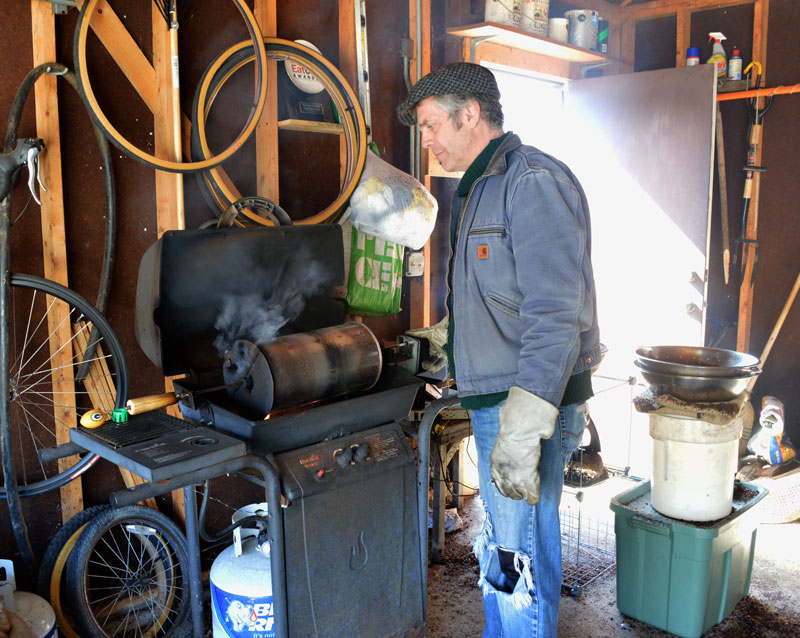
David Meyers, roasting coffee in Rogers Park, is the mind behind the Chicago Coffee Confederation and Café Chicago. (Megan Kramer/Medill)

Bringing it home

With the help of Chicago Fair Trade, Chicago became a fair trade city in May 2011, making it the largest such city in the U.S. and the third-largest globally after London and Toronto. Founded in 2006, Chicago Fair Trade comprises 70 member organizations including businesses, nonprofits and universities.

The Café Chicago project

In 2011 the Latino Union of Chicago and the Chicago Coffee Confederation, a group of small-batch coffee roasters, teamed up to create their own fair trade endeavor, Café Chicago, which takes the fair trade model and applies it locally. The company buys coffee beans from La FEM farmers, a farming cooperative in Esteli, Nicaragua, that is run entirely by women and focuses on women’s rights and empowerment.

Café Chicago then roasts, packages and sells the coffee to local restaurants, grocery stores and directly to consumers from its website. All proceeds go to the nonprofit Latino Union of Chicago, which works to improve social and economic conditions for low-income immigrant workers through various programs that address issues including unsafe working conditions, immigration reform and policies, and leadership and other training.

Café Chicago took the fair trade movement a step further not only by helping La FEM farmers and their families in Nicaragua but also by providing jobs for and teaching new skills to immigrant workers in Chicago.

Originally from Mexico City, Alejandro Serrano has worked as a roaster at Café Chicago for the last 18 months and says he is learning a lot on the job.

“We focus on improving our skills, learning every day more about coffee and the coffee roasting business,” he said. “We also focus on sales and on training new members so they can participate in the cooperative.”

Serrano says there are currently five people employed at Café Chicago in North Park and that the leadership of the organization has improved. They are working to expand the business in order to make it self-sufficient and separate from the Latino Union while still supporting it, Serrano said. Café Chicago advertises its coffee on Facebook and other websites.

Not without setbacks

Meanwhile, the Chicago Coffee Confederation has hit a few bumps in its conceptual road. David Meyers founded the confederation in 2009 when his original business venture, Resistance Coffee, started to grow. The group eventually comprised three fair-trade and organic coffee roasters – Grinderman Coffee, Miscellaneous Treats and Resistance Coffee – but is now much smaller.

“CCC is largely merely an idea now,” Meyers said. “Our other coffee roasters, who were great contributors to the development of Café Chicago, have moved to other cities.”

Even though Meyers acknowledges that fair trade as an alternative economic model can be a struggle due to factors like these, he said it can still be a movement for justice by “taking bites out of the capitalist economy and making it more social.”

Friday, March 23, 2012

Chicago’s Cafe YO! Combines Youth Jobs, Activism, and Caffeine

    Labor

Chicago’s Cafe YO! Combines Youth Jobs, Activism, and Caffeine

Kari Lydersen / In THESE TIMES

Monday, January 9, 2012

Cafe Chicago Hits the Ground Running, Stumbling, and Flying. All at the Same Time.


Cafe Chicago has hit the ground, running, stumbling, and flying. All at the same time.

First, the ground. We are creating a reality where the immigrant day laborers who are involved in Cafe Chicago can one day take it on fully, themselves, with the proper training. Personally, I did not know how much work this would be, but we are all committed to the idea, and the transfer is taking huge amounts of energy and time. That said, our cooperative members are taking on responsibilities as they can, and though it would have been easier to start a fair trade organic coffee company that funds social change and run by experienced outsiders, we really are maintaining a vision that we believe will prove to be where the deeper transformation happens, economic, social, and really, spiritual. Putting the workers in the drivers' seat.

We've had events at the Workers Center where 75 people showed up from all round Chicago, eager to learn about our work, wanting to take the ideas back to their communities, listening and singing along with the singer songwriters we've brought in to document our work in musical form. And it is here that we now realize, we've sparked a bona fide grassroots movement. From below. Pretty intense.

The cooperative has four regular members, and a dozen other day laborers involved in various ways, less regularly.

We've gotten huge name recognition in Chicago, while selling maybe 80-100 lbs of coffee per week (tiny!). We are working out so many glitches that come up with our language barriers, people's previous lack of experience of taking responsibility and ownership, lack of experience with business ....

But we seem to hit on the right methods slowly, and are good at bringing in outside support (for example, our college professor friend who is working on our Business Plan with us, has provided an amazing clarifying and focusing of our mission and our business). So, hitting the ground's proven to have quite a few stumbles, but we are learning to walk.

It helps to have a damn good rich and chocolatey coffee, from La FEM in the highlands of Nicaragua. At La FEM, the women who participate in the cooperative not only grow these magical beans but teach and learn construction and other building skills essential to further survival and thriving.

Our name recognition is coming through word of mouth; and a lot of writing skills put to good use in social media; the sway of the Latino Union and of the Chicago Coffee Confederation in different and complementary arenas; it's a real nice mish mash.

We have very good networks with almost all segments of Chicago's arts, radical, immigrant, worker, and progressive communities and our organizations. Our media work has exceeded all expectations, and is where we are flying: an article in internationally-read Latin American Herald Tribune; ChicagoUnionNews.com did a piece that put us in front of Chicago's unions (and national ones as well); and a piece on ABC7 News during primetime, probably the biggest visual media in Chicago, where we performed quite quite well. The New York Times will be around soon, it's the first media avenue I've begun to actively pursue.

All that said, we are now aware that we are not only a part of a large-scale economic seachange, but a leading voice. A tugboat. And we are keeping in mind, because we've sparked so many imaginations and tapped into a model of grasping and taking the reins of self-determination, that we can assist others in creating similar endeavors. Whether in coffee or other essentials. We hope to work with some of the other organizations in the National Day Labor Organizing Network, to establish ten more Cafe ______'s in different cities, by the end of 2013. They've been calling us, watching us, supporting us.

Locally, we've identified other niches where projects like worker-owned Cafe Chicago would have wide open space for success (such as a fair trade organic tortilleria), and rather than thinking we can do this too, will start working with others so that they can begin the process. Expanding horizontally, as the Chicago Coffee Confederation has, rather than vertically.

There's a lot more that could be said, but I wanted to let you know where we're at, and again thank you for your support, that support has proven to be vital to our sense that yes, we can do this, and others think so too.

So Thanks! And happy holidays to you ...

David

Sunday, January 8, 2012

Cafe YO! - Made by Artists: Made by Youth: Making Community and a New Economy.

It started seven years ago.

Loss of employment led a guy to start roasting 100% fair trade organic green coffee beans in a friend's garage. Then selling it, bartering it, trading it for sandwiches and shoes and shelter, making a living while also raising funds for social change efforts ranging from the Chicago Women’s Health Center to Radios Populares to the Latino Union to West Town Bikes.
This endeavor became known as Resistance Coffee, and maybe you’ve seen it on the shelf at Newleaf Natural Grocery in Rogers Park.
Over two years ago, this quirky success morphed – not by growing into a larger, vertical, vertigo-producing corporation, mind you, but horizontally.
Two other fellas took up the original model, roasting on homemade equipment (BBQ grills! Propane! Dilapidated Garages! A field in Michigan!) with little or no investment, and now have parallel micro-endeavors, Grinderman Coffee (grindermancoffee.com), and Miscellaneous Treats. This trio call themselves the Chicago Coffee Confederation. This trio have gone on to bring in serious creative energy, artists of all kinds to assist with graphics, writing, artwork, web design, and even music related to social change and … coffee.
Last year, two of these roasters, David Meyers of Resistance Coffee and Michael McSherry of Grinderman, started working closely with the Latino Union in the creation of a larger project, called Café Chicago (CafeChicago.org). Café Chicago has grown into the city’s first immigrant-run worker-owned cooperative coffee roaster, toasting up fair trade organic beans grown by the women of La FEM cooperative, funding the immigrant rights work of the Latino Union (latinounion.org). Day laborers who've stood on corners braving bitter cold and extreme heat and boredom waiting for jobs to turn up, are now taking on all aspects of a coffee-roasting business. Not for profit, but for people and community.
Now the gang are up to something yet again.
The next phase of this movement, which is largely about growing community, economic justice, and the leveraging of resources and talents for people and the environment not profit, is youth-focused.
It’s a coffee venture.
It's Café YO!.
Café YO! Youth Organizing, Youth Occupying. The economy and the community.
The idea taking shape is the creation of a city-wide, youth-oriented coffee company. Fair trade? Check. Organic? Of course. Workers make the decisions? Mais oui. The workers and the creators this time - with the generous support and talents of a burgeoning group of adult artists, writers, musicians, activists, organizers who meet weekly at the Hideout's fantastic Bread and Soup gatherings – are youth. From across the city, we are coming together to not only roast, package, sell, and distribute this amazing coffee, but also to travel to countries of origin to establish relationships with coffee growers from Mexico, Puerto Rico, Vietnam, and African countries.
Café YO! is also developing a citywide band of youth and adult musicians – bringing economics and creativity together in new ways. Another piece of the puzzle. Probably another story.
Café YO! is now making connections with teens around the city on street corners and through rad schools, and developing fundraising materials – a public relations packet, if you will. Funding will be forthcoming from various unions in Chicago and across the country, as well as from generous individuals of all stripes.
Consider supporting Cafe YO!. Your first reward? Making possible the very first stage of the very first youth-run, community-based fair trade organic coffee company in the country. In the world.
Your second reward? One day soon, drinking the coffee they bring.


Friday, December 9, 2011

ABC7 Chicago: Cafe Chicago promotes sustainably, job training

 Cafe Chicago promotes sustainability, 

job training

December 9, 2011 (CHICAGO)

The Latino Union is known for fighting for the rights of immigrants and specifically rallying for fair working conditions for day laborers. Now, the group is trying to move into sustainability for themselves and for the land.

Coffee beans are more than just a precursor to a morning jolt. They may be the seeds of economic independence.

"A lot of workers in the Latino Union needed work, but also needed a different sort of way of creating dignity," David Meyers, Chicago Coffee Confederation, said.

The Latino Union and the group of small batch coffee roasters known as the Chicago Coffee Federation is entering the coffee business with Cafe Chicago; the proceeds benefit the nonprofit Latino Union.

"A lot of people start really cool coffee companies that are fair trade and organic to fund social change and that's what we do, too. But we put the workers directly into the driver's seat," Meyers said.

The company is training day laborers who ordinarily work construction jobs to learn the coffee business. They are roasting, packaging and even marketing the product. The product is one they say they are proud to sell.

"We chose coffee from Nicaragua because Nicaragua has one of the best," Norberto Gonzalez, Cafe Chicago, said. "It's premium coffee. It's Arabica bean and it's actually from the higher mountains and it's shade coffee... The fertilizer has no chemicals. We use the skin from the bean as the fertilizer."

The local group has partnered farming cooperative in South America to grow the beans and guarantees the workers are paid a fair wage.

"Not only do we help a cooperative called La Fem farmers, female farmers in Nicaragua and their families, but also it's like the circle of life. It comes back to our workers here at Latino Union and we help their families," Marisol Willis, Cafe Chicago, said.

The packaging is made from recycled paper and is lined with a plant-based material. Cafe Chicago coffee is available in several area stores, and online at cafechicago.org.

Thursday, December 1, 2011

Lessons from Immigrant Workers: Occupying the Hood, Transforming the Economy - Illinois Humanities

 Lessons from Immigrant Workers: Occupying the Hood, Transforming the Economy

Day laborers in Albany Park have been occupying the only spaces open to them in the area for years while searching for work: street corners. Meanwhile, the coffee roasters of the Chicago Coffee Confederation have been occupying unused spaces like empty garages and backyards for close to a decade in order to bring great tasting fair trade organic coffee to the people while supporting the work of organizations like the Latino Union. The coming together of these two forces in Cafe Chicago is paving a new road towards economic self-determination and transformation.

Join us for this special Café Society conversation with members of the Albany Park Workers Center that promises to be heavy on dialogue and refreshments! Plus, Ami Saraiya and Anna Soltys will perform their original song “Sweet Chariot” inspired by and about day laborers.

Cafe Chicago coffee beans, by the pound, will be available for purchase for your holiday pleasure.

Reservations are required, reserve your spot here.

From “Brewing Justice at Café Chicago” by Kari Lydersen

“Waiting long hours on street corners for jobs, often in freezing weather, Chicago day laborers drink a lot of coffee. Now they will also be roasting and selling it. And rather than the watered-down McDonald’s or Aldi’s coffee they often drink, it will be organic fair trade coffee sold at sliding scale prices to make it affordable for people from all walks of life. This is Café Chicago, a new worker-owned cooperative under the auspices of the Latino Union and the Albany Park Workers Center. The project has been in the works for more than a year, and on May 1 will be selling its first bags of coffee….At a meeting in late March, said Café Chicago worker-owner Marisol Willis, 42, ‘We all came together as one, the energy was amazing. Everyone had their different skills and things they could offer. When you work together, everyone benefits. If we just keep that attitude, there’s no question of anything but success.’”

Questions for Consideration

When should people occupy a space? What can we learn from day laborers in Albany Park on occupying spaces in a healthy sustainable way? How can those involved in similar struggles develop horizontal relationships with other groups? How can alliances like these sustain a movement?

Want to learn more?

Free and open to the public. For more information please call 312.422.5580.

If you need a sign interpreter or require other arrangements to fully participate, please call 312.422.5580. For parking locations near the facility, please visit ChicagoParkingMap.com.

https://old.ilhumanities.org/events/lessons-from-immigrant-workers-occupying-the-hood-transforming-the-economy/